Eastern Mongolia
Eastern Mongolia contains one of the largest – and last – undisturbed steppe
ecosystems in the world, and is the core habitat of the Mongolian gazelle. There
are meandering rivers, large wetland areas punctuated by beautiful lakes, swathes
of multicolored wild flowers and huge herds of white-tailed gazelle. Besides the
grasslands, the major feature of the region is the Khan Khentii Mountains, where
was the birthplace of Genghis Khan.
Eastern Mongolia Land of Genghis Khan
 This is birthland of Genghis khan, where he was born and proclaimed off limits to
hunting and logging by him in the 13th century and provides vast expanses of rolling
grass steppe, home to some of the largest herds of black tailed gazelle, and some
part of eastern Mongolia is covered with tall, densely forested mountains to the
north and smaller foothills to the south. Where is the opportunity to ride a horse,
hiking top point of Khan Khentii Mountain Range Asralt Khairkhan, Mount Burkhan
Khaldun; known as God's Hill, in the Khentii Nuruu is one of the sites mooted as
the burial place of Genghis Khan also over 800 ancient burial sites have been found
in the region.
This is birthland of Genghis khan, where he was born and proclaimed off limits to
hunting and logging by him in the 13th century and provides vast expanses of rolling
grass steppe, home to some of the largest herds of black tailed gazelle, and some
part of eastern Mongolia is covered with tall, densely forested mountains to the
north and smaller foothills to the south. Where is the opportunity to ride a horse,
hiking top point of Khan Khentii Mountain Range Asralt Khairkhan, Mount Burkhan
Khaldun; known as God's Hill, in the Khentii Nuruu is one of the sites mooted as
the burial place of Genghis Khan also over 800 ancient burial sites have been found
in the region.
There are many places connected with Genghis khan where he battled, relaxed and
took a bath. Travelers visit in eastern part of Mongolia not only Genghis khan’s
birthplace but also there are some real advantage interesting places including Mongolian
Energy center, meditation caves and old Khamar Monastery through the establishment
of an inclusive public school, theatre, museum and library. There are now 108 stupas,
center of Energic and Khamar main temples. This is related with Danzanravjaa (Terrible
Noble Saint of the Gobi.)
Place of Genghis Khan
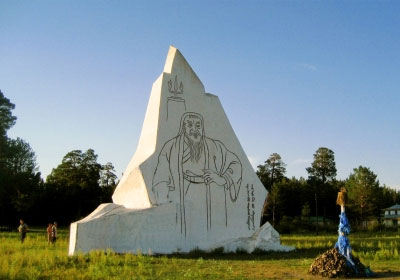
Khuduu Aral is a plain about 30 kilometers long and 20 kilometers wide on the meander
of the Kherlen River, west of the Kherlen Toono, and south of the mountain of Kherlen
Bayan Ulaan, at the altitude of 1.300 m above sea level. The site of Ikh Aurug (palace)
of Genghis Khan is on this plain. This site is closely connected with the historical
work "The Secret history of the Mongols" because it was finished exactly here; and
honored the 750th anniversary of this event; a historic monument was erected here
in 1990. Hereabouts are places such as Doloon Boldog and Shilhentseg, mentioned
in “The Secret history of the Mongols”
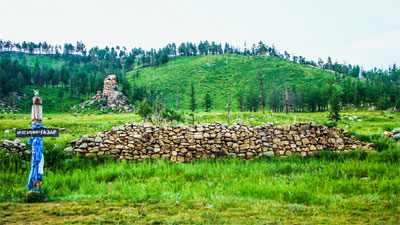 Oglogchiin Kherem (Oglogch Wall)
Oglogch Wall is located at the base of Daichin Mountain, 45km southwest of Batshireet
soum. The wall, 3km in length, is made entirely of stones without the use of mortar.
When Russian archeologist S. Kondratiev explored the site in 1926, the wall was
2.5-4.5 meters in height. Today it stands 3.1 meters tall at its highest point.
In year 2005, Mongolian-American joint expedition team "Genghis Khan" discovered
approximately 60 tombs near the wall. The archeologists believe that Oglochiin Kherem
may be a burial place of great Mongolian figures, such as Genghis or Kublai Khan.
Mount Burkhan Khaldun
This remote mountain, known as God's Hill, in the Khentii Nuruu is one of the sites
mooted as the burial place of Chinggis Khaan. Over 800 burial sites have been found
in the region, though the main tomb has yet to be located. Whether or not Genghis
was buried here, The Secret History of the Mongols does describe how the khan hid
here as a young man and later returned to give praise to the mountain and give thanks
for his successes. Because of its auspicious connections, Mongolians climb the mountain,
which is topped with many ovoo, to gain strength and good luck. The hill is very
remote, in the Khan Khentii Strictly Protected Area. To get there, head to Mongonmorit
in Tov, then travel north along the Kherlen Gol. This is also a great place to reach
by horse.( Mongolia. Lonely Planet Publications Pty Ltd.)
The Dark Blue Pearl
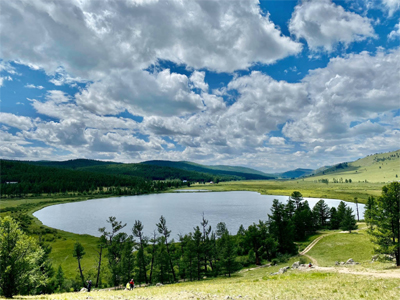 Known as “The Dark Blue Pearl” it is the largest tributary stream of Lake Baikal in Russia. Khuvsgul is 136 km long, water beneath 100 meters & 36 km wide, 262 meters deep and is located at an altitude of 1645 m above sea level and is frozen from January until April or May. A ferryboat operates between Khatgal and Khankh, two towns on the southern and northern shores of the lake that are within the boundaries of the Khuvsgul National Park. 96 rivers and streams flow out of Khuvsgul, among them the Egiin River, which then joins the Selenge along its eventual path to Lake Baikal Lake, Lake Khuvsgul is not only pure, deepest one but also Fishes Lake in Mongolia such as Baikal Omul, Lenok, Umber, Siberian Grayling and River Perch It's inhabited by nine species of fish including the Baikal Omul, River Perch, Umber Siberian grayling and lenok. Fishing and sport fishing are becoming popular in the lake area.
The lake has 4 islands- Khadan khuis, Modon khuis, Dalait khuis and Baga khuis. The largest is Dalait khuis (6 square km), and is covered with forest. Taiga Fauna and Flora, Tsatan, practicing reindeer breeding are the main attractions for tourist. Lake Khuvsgul is on the important migration route for birds from Siberia, thus facilitating marvelous opportunities for bird watching. The best time to visit lake is in spring, when it rains less and the flowers and bird life are often at their best - but it will still be very cold, and the lake may still be frozen. The summer is a little more crowded (not so crowded that it would spoil your trip), would be sometimes rain. The meadows around the lake are sprinkled with beautiful wildflowers during this time. Autumn is another good time to visit, when the leaves are turning color. Winter is amazingly cold, though blue skies are the norm. The lake freezes over and you can drive up over the lake and enjoy the disorientating feeling of looking down through the ice to the lake floor. Nomads say that the lake is at its most beautiful during this time.
SOME OF OUR Partners